
Your cart is currently empty!
STATIC QUESTIONS-ART AND CULTURE
ART AND CULTURE SHORT NOTES:
1. Paryushan Parv is a significant festival in Jainism, celebrated all over India. It involves fasting, penance, meditation, and self-reflection, aiming for soul purification and vowing to avoid future transgressions.
2. Bojjannakonda, a centuries-old Buddhist heritage site in (at Sankaram, near Visakhapatnam) Andhra Pradesh. The main stupa at Bojjannakonda is a rock-carved structure covered with bricks and adorned with Buddha sculptures. Lingalametta boasts rows of rock-cut monolithic stupas. The site is famous for many votive stupas, rock-cut caves, brick-built edifices, early historic pottery, and Satavahana coins that date back to the 1st century AD. These sites show elements of all the three Buddhist phases: • Theravada (Lord Buddha was considered a teacher) • Mahayana (Buddhism was more devotional) • Vajrayana (Buddhist tradition was more practised as Tantra and in esoteric form)
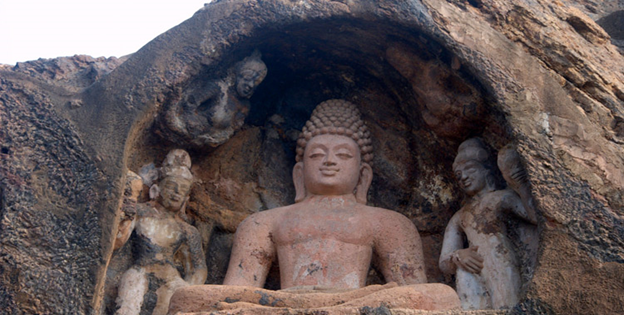
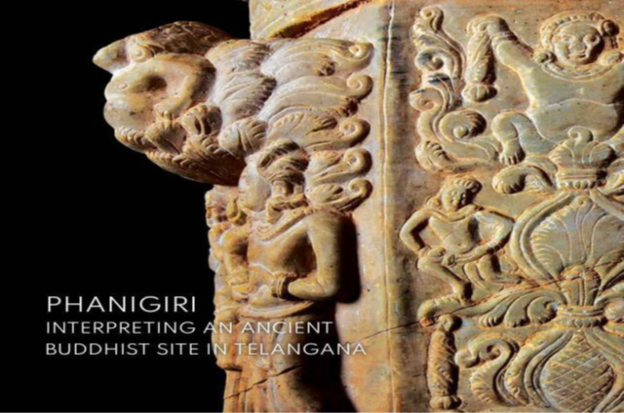
3. Phanigiri Buddhist artefacts, discovered in 1942 and dating from 200 BCE to 400 CE, are currently showcased at the New York Metropolitan Museum of Art .Phanigiri, often referred to as the “hillock of snake hood,” is a small village approximately 150 km from Hyderabad, with significant historical and spiritual significance in Buddhism. Findings at Phanigiri: • Remarkable findings at Phanigiri are a set of thoranas, which are stone gateways, and one of these thoranas displays both Mahayana and Hinayana schools of Buddhist thought, suggesting coexistence despite philosophical differences. • Phanigiri provides evidence of the deification of Buddha and a transition towards canonization and ritual in Buddhist practices. • The artefacts from this site, including a limestone carving of Buddha wearing what appears to be a Roman toga, are considered highly important and are now part of the exhibition in New York.
4. Kapilvastu is in southern Nepal, near the Indian border. Lumbinī is a Buddhist pilgrimage site in Nepal. It is the place where, according to Buddhist tradition, queen Maya gave birth to Siddhartha Gautama at around 566 BCE. 5. Shakyas who ruled Kapilavastu after Buddha’s Parinirvana did not have an army, and many were massacred in Sagarahawa. Eventually, the remaining Shakyas fled to different parts of Greater Magadha and to far-flung places like Gandhara (modern-day Afghanistan) and Burma (Myanmar). Many also went to the Kathmandu valley and were granted a status comparable to that of the Vajracharya priests (Vajracharya is a general term of respect for a teacher) but they were not permitted to practise priesthood outside of their families.
6. Dholavira site: The site has a fortified citadel, a middle town and a lower town with walls made of sandstone or limestone instead of mud bricks in many other Harappan sites. Archaeologists cites a cascading series of water reservoirs, outer fortification, two multi-purpose grounds — one of which was used for festivities and as a marketplace — nine gates with unique designs, and funerary architecture featuring tumulus — hemispherical structures like the Buddhist Stupas— as some of the unique features of the Dholavira site. While unlike graves at other IVC sites, no mortal remains of humans have been discovered at Dholavira. Remains of a copper smelter indicate of Harappans, who lived in Dholavira, knew metallurgy. It is believed that traders of Dholavira used to source copper ore from present-day Rajasthan and Oman and UAE and export finished products. It was also a hub of manufacturing jewellery made of shells and semi-precious stones, like agate and used to export timber.
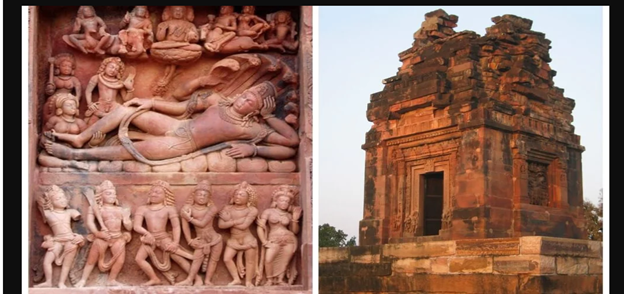
7. Gupta art and architecture: Both the Nagara and Dravidian styles of art evolved during this period. But most of the architecture of this period had been lost due to foreign invasions like that of Huns. Metallurgy had also made a wonderful progress during the Gupta period. The craftsmen were efficient in the art of casting metal statues and pillars. The Delhi Iron pillar of the Gupta period is still free from rust though completely exposed to sun and rain for so many centuries. The temple at Deogarh near Jhansi and the sculptures in the temple at Garhwas near Allahabad remain important specimen of the Gupta art (dedecated to bhagnan vishnu)
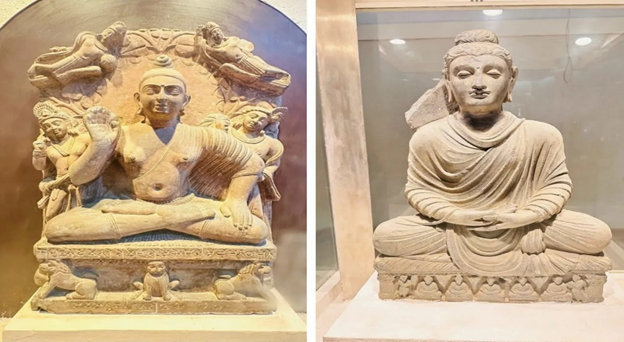
There was no influence of Gandhara style. But the beautiful statue of standing Buddha at Mathura reveals a little Greek style.
8. The style of temple architecture that became popular in northern India is known as nagara. In North India it is common for an entire temple to be built on a stone platform with steps leading up to it. Further, unlike in South India it does not usually have elaborate boundary walls or gateways. While the earliest temples had just one tower, or shikhara, later temples had several. The garbhagriha is always located directly under the tallest tower
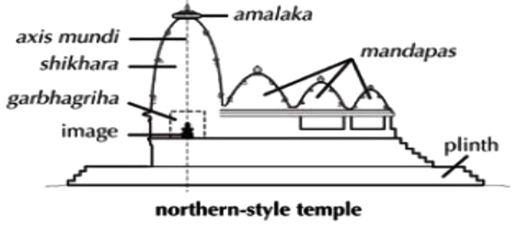
9. Kashmir’s proximity to prominent Gandhara sites (such as Taxila, Peshawar and the northwest frontier) lent the region a strong Gandhara influence by the fifth century CE. The Karkota period of Kashmir is the most significant in terms of architecture. One of the most important temples is Pandrethan, built during the eighth and ninth centuries. In keeping with the tradition of a water tank attached to the shrine, this temple is built on a plinth built in the middle of a tank. Although there are evidences of both Hindu and Buddhist followings in Kashmir, this temple is a Hindu one, possibly dedicated to Shiva. The architecture of this temple is in keeping with the age-old Kashmiri tradition of wooden building.
10. Karnataka school of architecture, it was conceptualized under the later Chalukya rulers in the mid-seventh century A.D. It combined features of both Nagara school and Dravidian school and resulted in a hybridised style. Some of its features are: • Emphasis on vimana and mandapa • Open ambulatory passageway • The pillars, doorways and the ceilings were decorated with intricate carvings. Influence of Nagara style is in Curvilinear Shikhara and square base of Vesara temples. Influence of Dravida style is seen in intricate carvings and sculptures, design of Vimana and Step or terraced Shikara of Vesara temples. Example: Doddabasappa temple at Dambal, Ladkhan temple at Aihole, temples at Badami etc. 11. The guidelines for declaring a language as ‘Classical’ are:
- High antiquity of its early texts/recorded history over a period of 1500-2000 years;
- A body of ancient literature/texts, which is considered a valuable heritage by generations of speakers.
- The literary tradition be original and not borrowed from another speech community.
- The classical language and literature being distinct from modern, there may also be a discontinuity between the classical language and its later forms or its offshoots.
12. Bhasha Samman awards will be given to scholars who have done valuable work in the field of classical and medieval literature. 13. In some Sanskrit sources, the usage of the words “Yona”, “Yauna”, “Yonaka”, “Yavana” or “Javana” etc. appears repeatedly, and particularly in relation to the Greek kingdoms which neighboured or sometimes occupied the Punjab region over a period of several centuries from the 4th century BCE to the first century CE. The Yavanas are mentioned in detail in Sangam literature epics such as Pattinappalai, describing their brisk trade with the Early Cholas in the Sangam period.